We have compiled a list of manufacturers, distributors, product information, reference prices, and rankings for Silicone Coating.
ipros is IPROS GMS ・ IPROS One of the largest technical database sites in Japan that collects information on.

Silicone Coating Product List and Ranking from 7 Manufacturers, Suppliers and Companies | IPROS GMS

Last Updated: Aggregation Period:Oct 28, 2026~Nov 24, 2026
This ranking is based on the number of page views on our site.

Silicone Coating Manufacturer, Suppliers and Company Rankings

Last Updated: Aggregation Period:Oct 28, 2026~Nov 24, 2026
This ranking is based on the number of page views on our site.

  1. 吉田SKT Aichi//Manufacturing and processing contract
  2. null/null
  3. サーフテクノロジー 本社 Kanagawa//Pharmaceuticals and Biotechnology
  4. 4 マスオカ東京 Tokyo//Rubber products
  5. 5 技研 本社 Ibaraki//Manufacturing and processing contract

Silicone Coating Product ranking

Last Updated: Aggregation Period:Oct 28, 2026~Nov 24, 2026
This ranking is based on the number of page views on our site.

  1. What are the methods to prevent mold eye discharge? Introducing improvement cases through surface treatment. 吉田SKT
  2. Silicone-based coating
  3. [Case Study on Problem Solving through Surface Treatment] Prevention of Adhesive Adhesion on Cutter Blades 吉田SKT
  4. 4 Silicone-based coating "Infinity530" サーフテクノロジー 本社
  5. 4 [New Product] Release and Non-Stick Coating Compliant with Food Sanitation Law PL System 吉田SKT

Silicone Coating Product List

1~18 item / All 18 items

Displayed results

[Food Industry Case Study] Surface Treatment of Measuring Cups for Draining Whipped Cream

MRS silicone coating suitable for the food sector. With a thin film of about 1μ, it has almost no risk of foreign matter contamination, excellent liquid repellency, and is ideal for preventing liquid retention and adhesion.

We would like to introduce a case of surface treatment that improved the liquid drainage of measuring cups. ■Concern In the case of a standard measuring cup, liquid was drained by either tilting it at a steep angle or shaking it by hand. Particularly with heavy cream, the drainage was poor, requiring multiple shakes or the use of a spoon. Initially, we considered Teflon coating, but it did not perform well with heavy cream. ■Request When we received the consultation, the client was using a thin-film fluorine coating from another company, but there were many inconsistencies in the processing, and the liquid drainage was unstable, sometimes good and sometimes bad. ■Coating that solved the issue MRS-014 ■Background of adoption At Yoshida SKT, we produced a prototype of the MRS coating, which is a food-safe type with a thin film. By combining it with a special base treatment, we achieved good liquid drainage even with heavy cream. The ability to pour at a right angle also improved workability. The MRS coating is about 1μm thick, so there is almost no risk of volume error or foreign matter contamination. Additionally, at the World Bartender Championship, the ability to pour at a right angle was well received for making the actions look elegant. *For product details, please refer to the PDF.

  • Surface treatment contract service
  • Silicone Coating

Added to bookmarks

Bookmarks list

Bookmark has been removed

Bookmarks list

You can't add any more bookmarks

By registering as a member, you can increase the number of bookmarks you can save and organize them with labels.

Free membership registration

Solving the challenges of silicone (silicon) release agents with silicone coatings.

We will solve the challenges of silicone (silicon) release agents with silicone coatings!

■What is a release agent? In the industrial field, a release agent is known as a substance applied to improve the separation of molded products from molds. In a broader sense, substances like the flour used to prevent soba noodles from sticking during preparation can also be referred to as release agents. ■Silicone (Silicon) Release Agents Release agents used for molds include silicone and fluorine, depending on the material and conditions. In addition to facilitating mold release, release agents must also have properties that make them resistant to degradation from heat during molding and minimize contamination of the mold. Silicone has high heat resistance and is less likely to degrade with repeated heating during molding. Additionally, due to its low surface tension, it has good wettability on molds, allowing it to reach every corner of the shape, which is one reason it is commonly used as a release agent. ■Release Agents and Coatings In addition to release agents, coatings can also provide release effects. While release agents are an easy means of achieving mold release, they can impose burdens on the working environment, complicate mold cleaning, and lead to variations in the amount applied by workers, potentially negatively affecting the final product. In such cases, release coatings may offer solutions to these challenges. ▼For more details, please see here.

  • Injection Molding Machine
  • Silicone Coating

Added to bookmarks

Bookmarks list

Bookmark has been removed

Bookmarks list

You can't add any more bookmarks

By registering as a member, you can increase the number of bookmarks you can save and organize them with labels.

Free membership registration

Excellent Features of Silicon Processing

Non-stick coating! Introducing various features of silicone processing, such as heat resistance and cold resistance!

We would like to introduce the excellent features of silicone processing. Silicone processing refers to the coating of a material's surface with silicone resin. Depending on the application, we have various unique processing methods, and it is widely used in everyday products and industrial fields. It has various excellent features, including heat resistance that can withstand temperatures above 200°C, cold resistance from -40°C to 55°C, and water repellency. We also provide information on the difference between silicone and silicones. 【Features】 ■ Heat resistance ■ Cold resistance ■ Water repellency ■ Non-stick property ■ Insulation ■ Safety *For more details, please refer to the PDF document or feel free to contact us.

  • Other contract services
  • Processing Contract
  • Silicone Coating

Added to bookmarks

Bookmarks list

Bookmark has been removed

Bookmarks list

You can't add any more bookmarks

By registering as a member, you can increase the number of bookmarks you can save and organize them with labels.

Free membership registration

[Coating Processing Example] Preventing Adhesive and Sticky Tape Adhesion to Rolls

Heat-resistant up to 200℃! 'PC1137' can also be processed into metal rolls and CFRP rolls.

We would like to introduce a case study of 'PC1137' handled by Osaka Gas Chemical Co., Ltd. This product is suitable when you want to prevent adhesives and other substances from adhering to rolls, as it does not allow any adhesive tape to stick at all. It can be applied to rolls with a diameter of up to 2,000 mm and a length of 9,800 mm, making it applicable not only to metal rolls but also to CFRP rolls. There are several options for silicone coatings, and depending on the application, there are differences in surface preparation, film thickness, and surface roughness. We will propose the most suitable combination, so please consult with us first. Additionally, we can send samples of approximately 60×40 to those who request them, so feel free to contact us.

Added to bookmarks

Bookmarks list

Bookmark has been removed

Bookmarks list

You can't add any more bookmarks

By registering as a member, you can increase the number of bookmarks you can save and organize them with labels.

Free membership registration

Silicone-based coating "Infinity530"

Not subject to PFOA/PFAS regulations! Reduces energy costs and shortens production time *Can also comply with PFAS regulations.

"Infinity530" is a promising silicone-based coating that serves as an alternative to fluoropolymer coatings. It offers non-stick properties comparable to fluoropolymer coatings while achieving high heat resistance and high wear resistance. This results in reduced energy costs and shorter production times. Additionally, the strength of the siloxane bond (-Si-O-Si-) is enhanced by methyl groups (-CH3), which also provide water repellency and adhesion suppression. 【Features】 ■ Heat resistance ■ Non-stick properties ■ Thermal conductivity ■ Safety ■ Wear resistance *For more details, please download the PDF or feel free to contact us.

  • Other contract services
  • Silicone Coating

Added to bookmarks

Bookmarks list

Bookmark has been removed

Bookmarks list

You can't add any more bookmarks

By registering as a member, you can increase the number of bookmarks you can save and organize them with labels.

Free membership registration

[Case Study on Problem Solving through Surface Treatment] Prevention of Adhesive Adhesion on Cutter Blades

Improving the poor cost-effectiveness of applying release agents! We will introduce a case of switching to silicone-based coatings.

We would like to introduce a coating that can solve the problems caused by adhesive from packaging films adhering to cutter blades. In one packaging machine, packaging films with adhesive frequently adhered to the cutter blades, resulting in poor cutting performance and film sticking to the blades, causing misalignment and necessitating line stoppages. This issue prevented us from achieving the production quantities calculated from the takt time. Initially, a release agent was applied, but its effects did not last, requiring repeated applications. Therefore, we adopted the silicone-based coating "MRS Coating." The coating eliminated adhesive adhesion, and since the processing temperature is below 250°C, there were no concerns about blade dulling. Additionally, the 1-micron thin film maintained the sharpness of the blade edge. [Key Points of the Case] - Purpose of Surface Treatment: Quality improvement, operational stability, speed enhancement, compliance with safety and environmental requirements - Required Functions: Non-stick, release properties, long lifespan - Treatment Adopted: MRS Coating (Mold Release Silicone) ▼ Free samples of improvement cases for the cutting process and trial sets are currently available on the site below! ▼

  • IMG_1880_edited.jpg
  • IMG_1889_edited2.jpg
  • Processing Contract
  • Silicone Coating

Added to bookmarks

Bookmarks list

Bookmark has been removed

Bookmarks list

You can't add any more bookmarks

By registering as a member, you can increase the number of bookmarks you can save and organize them with labels.

Free membership registration

[Free Offer] Innovative Silicone Coating for Tackiness Solutions in Products

Experience the "innovative silicone coating" designed to tackle sticky, unmanageable surfaces that cannot be handled with Teflon coating!

For preventing the sticking of sticky adhesive substances, which does not work well with Teflon coatings or fluororesin coatings, the following general measures have been taken, but there are limitations. ≫ Silicone release agents These are spray-type agents that can be easily applied by on-site workers and are familiar as release agents for resin molding. → However, they lack durability in their effectiveness, requiring frequent reapplication, and when wiped off with solvents for cleaning, the release agent is also removed. ≫ Surface roughening (physically reducing contact area) By making the surface of the components uneven, it becomes less likely for things to stick. There are many examples where combining this with Teflon coatings enhances effectiveness. → However, there are concerns about the risk of defective products due to the uneven shape being transferred to the product, and the difficulty of wiping or cleaning during maintenance due to the roughness. Our company has further evolved a smooth silicone coating that is effective against sticky adhesive substances and allows for solvent cleaning, tailored to the "troubles" faced on-site. We are currently offering a "feel the effect kit" for free! The "experience kit" can be requested from the official Yoshida SKT website.

  • s-CIMG3371_edited.jpg
  • ホットメルト1.jpg
  • SnapShot(0)1.jpg
  • ipmrs1.jpg
  • Bag making machine/slitter
  • Silicone Coating

Added to bookmarks

Bookmarks list

Bookmark has been removed

Bookmarks list

You can't add any more bookmarks

By registering as a member, you can increase the number of bookmarks you can save and organize them with labels.

Free membership registration

"Hard coat" with excellent non-adhesiveness and release properties.

In the adhesive tape release test, the force to peel off the tape is zero! The MRS coating can easily peel off sticky substances like adhesive tape and seals.

The "MRS Coating" (Mold Release Silicone) is a non-stick, release agent coating that possesses characteristics not found in conventional silicone coatings. In particular, MRS-014 is a thin film with a hardness of 9H, making it hard and excellent in non-stick and release properties. "MRS-014" - Non-stick (release) + Film hardness (9H) It is used to prevent sticking in cutting blades of automatic packaging machines, achieving improved production efficiency and reduced defect rates. [Other Series Features] - Non-stick (release) + Solvent resistance → MRS-102 - Non-stick (release) + Heat resistance (300°C) → MRS-004 - Non-stick (release) + Slipperiness → MRS-003 - Non-stick (release) + Low-temperature processability → MRS-200 Each series has various features, but the standard MRS coating has a smooth surface that makes it easy to wipe off dirt. Additionally, there are grades that show little change in release properties even when cleaned with solvents. *Based on our tests For more details, please download the PDF or contact us.

  • IMG_1889_edited.jpg
  • s-2021-06-22 (2).gif
  • Surface treatment contract service
  • Silicone Coating

Added to bookmarks

Bookmarks list

Bookmark has been removed

Bookmarks list

You can't add any more bookmarks

By registering as a member, you can increase the number of bookmarks you can save and organize them with labels.

Free membership registration

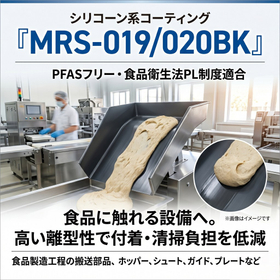
[New Product] Release and Non-Stick Coating Compliant with Food Sanitation Law PL System

Equipment for contact with food. Reducing adhesion and cleaning burden with PL system compliance and high release properties 'MRS-019/020BK'.

The new products "MRS-019/MRS-020BK" feature a silicone coating that complies with the Food Sanitation Act PL system, making them easy to use in equipment and materials that come into contact with food. The excellent non-stick properties of the MRS series help reduce adhesion of rice, dough, seasonings, and more, contributing to a decrease in cleaning burden and improved work efficiency. MRS-019 is suitable for situations requiring solvent resistance, while MRS-020BK is ideal for applications that demand high coating hardness. 【Features】 ■ Complies with the Food Sanitation Act PL system ■ High non-stick properties reduce adhesion issues ■ Selectable based on application needs such as solvent resistance and high hardness For use in conveying parts, hoppers, chutes, guides, plates, and other components in food manufacturing processes. For more details, please download the PDF or contact us.

  • Food Processing Equipment
  • Silicone Coating

Added to bookmarks

Bookmarks list

Bookmark has been removed

Bookmarks list

You can't add any more bookmarks

By registering as a member, you can increase the number of bookmarks you can save and organize them with labels.

Free membership registration

Silicone coating

For anti-adhesion and dirt prevention.

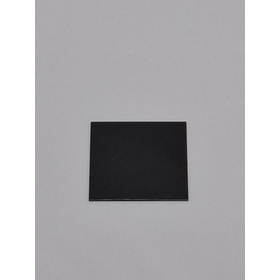
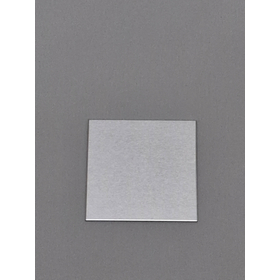
It is also effective in preventing sticking and dirt on frying pans and pots. As a release agent, it is an effective coating as an alternative to fluororesins, famously known under the "Teflon" trademark. You can try the free sample in the image. Please contact us. (Sample size of the coated plate: 50mm × 50mm × 1mm)

  • Processing Contract
  • Surface treatment contract service
  • Coating Agent
  • Silicone Coating

Added to bookmarks

Bookmarks list

Bookmark has been removed

Bookmarks list

You can't add any more bookmarks

By registering as a member, you can increase the number of bookmarks you can save and organize them with labels.

Free membership registration

Silicone Coating [Prevents production troubles caused by stickiness!]

[Sample available] Easy release even for molded products that are not fully set yet!

The "MRS series" is a silicone coating that allows for easy release from uncured molded products. By combining it with one of the three properties: solvent resistance, high hardness, and high heat resistance, we can prevent production troubles caused by stickiness. 【Features】 ■ Solvent resistance ■ High hardness ■ High heat resistance ■ Non-sticky *Samples are available upon request. If you would like a sample, please apply through the [Contact Us] section. *You can view the product documentation from the [Download] section.

  • Other machine elements
  • Silicone Coating

Added to bookmarks

Bookmarks list

Bookmark has been removed

Bookmarks list

You can't add any more bookmarks

By registering as a member, you can increase the number of bookmarks you can save and organize them with labels.

Free membership registration

Technical Data: Prevention of Aluminum Leaching through Silicone Processing

Prevent aluminum leaching from glass containers! Technical documentation on processing technology to suppress aluminum leaching from glass into pharmaceuticals.

Silicone processing involves covering the glass surface with a silicone film and applying a water-repellent treatment. Our company has been working on improving and enhancing silicone processing technology, and we have been able to develop a method to prevent aluminum leaching from glass. This document introduces a method to prevent aluminum leaching from glass into pharmaceuticals. [Contents] - Effect of aluminum leaching prevention (Albumin additives, phosphate buffer solution, citrate buffer solution, phthalate buffer solution, borate buffer solution, injection water) - Comparison of each treatment method - Measurement of time-dependent changes - Temperature dependence of leaching rate constants - Comparison of filling liquids - Comparison of glass treatment methods This document clearly explains the aluminum leaching prevention effect from glass containers! Using diagrams and tables, it provides an easy-to-understand overview of the effectiveness of silicone coating. You can download the document immediately from "PDF Download." Please take a moment to read it!

  • Other polymer materials
  • Silicone Coating

Added to bookmarks

Bookmarks list

Bookmark has been removed

Bookmarks list

You can't add any more bookmarks

By registering as a member, you can increase the number of bookmarks you can save and organize them with labels.

Free membership registration

[Surface Treatment Solution Case] Improved Extrusion Molding Troubles of Elastomers!

Prevent eye discharge when extruding elastomers. Reduce defects with mold release surface treatment!

■Concerns We received an inquiry from a customer who is prototyping a new elastomer extrusion product. They wanted to resolve the issue of unstable production due to adhesion to the extrusion mold. ■Background for Coating Adoption Initially, the adhesion was so severe that it was impossible to form the product, but after adopting our surface treatment, they were able to prevent adhesion to a degree that allowed production. However, during continued mass production, it was discovered that defects due to the adhesion of eye mucus occurred after about a month of use. ■Selected Surface Treatment 'MRS Coating MRS-102' ■Selection Process and Effects To further address the defects, we proposed MRS-102. Although eye mucus did occur during testing, it did not adhere to the mold and could be easily removed, which helped suppress the occurrence of defects, allowing for continuous use for six months. *For more details on the adopted 'MRS-102', please refer to the materials or contact us.*

  • ホットメルト_edited.jpg
  • s-CIMG3371_edited_edited.jpg
  • Processing Contract
  • Silicone Coating

Added to bookmarks

Bookmarks list

Bookmark has been removed

Bookmarks list

You can't add any more bookmarks

By registering as a member, you can increase the number of bookmarks you can save and organize them with labels.

Free membership registration

What are the methods to prevent mold eye discharge? Introducing improvement cases through surface treatment.

Preventing eye discharge that occurs during extrusion molding. Successfully stabilizing product quality through surface treatment of molds!

Mold release residue refers to foreign substances that adhere to the surface of molded products when forming thermoplastic materials such as resins and rubber. To prevent this residue, it is necessary to avoid material retention in the mold. When appropriate material selection and molding conditions cannot resolve the issue, adopting a surface treatment with excellent release properties is effective. Here are examples of improvements in mold release residue through surface treatment. ■ Concern We received an inquiry from a customer who was prototyping a new elastomer extrusion product. They wanted to resolve issues related to product stability due to adhesion in the extrusion mold. ■ Background for Coating Adoption Initially, the adhesion was so severe that it was impossible to form the product, but after adopting our surface treatment, we were able to prevent adhesion to a level that allowed for production. However, during continued mass production, it became apparent that defects due to residue adhesion occurred after about a month of use. ■ Selected Surface Treatment 'MRS Coating MRS-102' *For details on 'MRS-102', please download the PDF or contact us. The effects of the surface treatment are listed below.

  • ホットメルト_edited.jpg
  • s-CIMG3371_edited_edited.jpg
  • Processing Contract
  • Silicone Coating

Added to bookmarks

Bookmarks list

Bookmark has been removed

Bookmarks list

You can't add any more bookmarks

By registering as a member, you can increase the number of bookmarks you can save and organize them with labels.

Free membership registration

[Surface Treatment Case] MRS Coating Solves Challenges in Adhesive Tape Transport

We will introduce examples of how it has become possible to prevent the adhesion of paste and the wrapping of tape.

■Issues to be Resolved The adhesive from the packing tape was adhering and accumulating on the tape transport rollers, causing tape entanglement. As a result, manual cleaning was necessary, leading to unavoidable line stoppages. ■Solution MRS coating was applied to the surface of the rollers to improve their non-stick properties. ■Effects Adhesion of the adhesive and tape sticking were eliminated, resolving the line stoppages. The effort required for cleaning was significantly reduced, leading to improved production efficiency. ■Summary of the Case MRS coating is a coating technology that excels in non-stick properties for adhesive tapes. In this case, by applying MRS coating to the packing tape transport rollers, we successfully prevented adhesive accumulation and tape sticking, resolving line stoppages and improving production efficiency.

  • ホットメルト_edited.jpg
  • s-CIMG3371_edited_edited.jpg
  • Surface treatment contract service
  • Silicone Coating

Added to bookmarks

Bookmarks list

Bookmark has been removed

Bookmarks list

You can't add any more bookmarks

By registering as a member, you can increase the number of bookmarks you can save and organize them with labels.

Free membership registration

Reasons why silicone excels in release properties - Low surface tension.

The property of good repellency creates water resistance and release properties. MRS further imparts solvent resistance and hardness, among others.

The main reason why silicone coatings excel in release properties is their "excellent repellency (low surface tension)." This property exhibits "water repellency" against water and "release properties" against sticky substances. Because silicone has low surface tension, it does not easily adhere to other materials, resulting in superior release and water-repellent properties. MRS coatings are an innovative coating that leverages these silicone properties while incorporating characteristics such as solvent resistance, high hardness, and high heat resistance, which were difficult to achieve with conventional silicone coatings.

  • Surface treatment contract service
  • Silicone Coating

Added to bookmarks

Bookmarks list

Bookmark has been removed

Bookmarks list

You can't add any more bookmarks

By registering as a member, you can increase the number of bookmarks you can save and organize them with labels.

Free membership registration